INVESTOR'S GUIDE
SPORTS AND LEISURE INFRASTRUCTURE IN DUBAI: HOW TO VALUE PROPERTY NEXT TO IT
September 9, 2026 · 10 min read
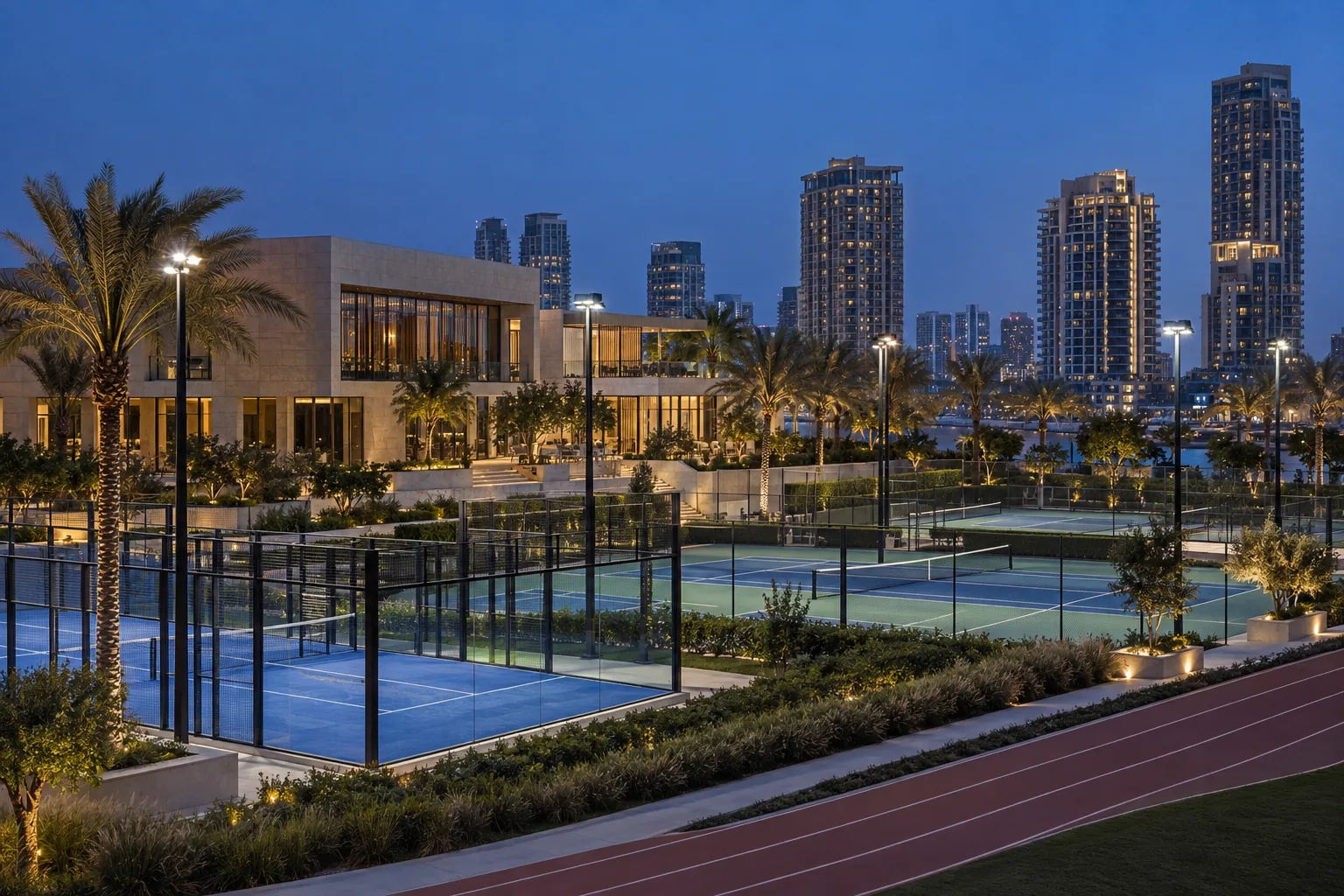
Sports and leisure infrastructure sells property. A stadium in the masterplan, an academy partnership, a championship golf course, a precinct built around courts and pitches: these appear in Dubai launch material because they work, and because buyers reliably attach value to them.
Whether that value is real is a separate question, and it is answerable. Proximity to a sports facility is not a single thing with a single effect on price. It depends on whether the facility exists, what kind of facility it is, how close you actually are, who pays to run it, and who will want the address from you when you sell.
This guide sets out how to work through those questions before you pay for the amenity. It deliberately does not quote a premium figure, because a single percentage applied across facilities, distances and communities would be inventing precision that the evidence does not support.
FIRST: DOES THE FACILITY EXIST?
This is the error that costs buyers the most, and it is the easiest to avoid. A facility in a brochure occupies one of four very different states, and they are frequently described in identical language.
1. Operating. Built, open, running. You can visit it, and you can see whether anyone is using it. This is the only state that is certain.
2. Under construction. Contractor appointed, works visibly progressing on site, a completion date the developer will state in writing. Strong, but still a date that can move.
3. Committed but not started. Approved and budgeted, nothing on the ground. The gap between this and the previous state is where most disappointment lives.
4. Announced or masterplanned. It appears on a plan. It may be built, in some form, at some point. It is not a reason to pay more today.
Ask which of the four applies, and ask for it in writing rather than in a viewing conversation. For anything not yet operating, the useful questions are narrow: is a main contractor appointed, have works commenced on site, and what is the stated completion date? A developer who will commit to those in writing is describing a project. One who redirects to the vision of the masterplan is describing an intention.
Price the property on what exists today. If the facility is delivered and the address improves, that is upside you did not pay for. If you pay for it in advance and it slips by three years, or arrives at half the promised scale, you have funded the developer's marketing with your own capital.
The delivery record of the developer is the best available evidence on whether phase-two amenities actually arrive. Our review of Dubai developers covers what to look at, and our note on off-plan versus ready property covers how to weigh a promise against a completed asset.
NOT ALL SPORTS FACILITIES AFFECT AN ADDRESS THE SAME WAY
The category "sports facility" contains two things that behave in opposite directions for a residential owner.
Participation facilities (community pitches, courts, pools, running and cycling routes, academies, gyms) are used by the people who live there. They generate daily, local, low-intensity activity. For a residential address this is close to unambiguously positive: households value them, they support family demand, and they make a community easier to let and easier to sell.
Spectator venues (stadiums, arenas, event circuits, tournament courses) are used by people who travel in. They generate concentrated, periodic, high-intensity activity: traffic, crowds, parking pressure, noise, road closures, floodlighting, and a schedule you do not control. For nearby retail and hospitality that footfall is the entire commercial case. For a residential unit on the wrong side of the access road, it is a reason the tenant does not renew.
The distinction matters because launch material blurs it. "Adjacent to a world-class sporting venue" reads as an amenity in a brochure and can be a nuisance in a lease. Before buying near a spectator venue, establish the event calendar, the access and egress routes, where visitor parking is intended to go, and what happens on the busiest day of the year. Then visit on an event day if you possibly can. That single visit tells you more than the entire marketing pack.
PROXIMITY IS NOT ONE DISTANCE
"Near the sports precinct" covers positions that behave very differently, and the difference is not linear with distance.
- Walkable but separated. Usually the strongest residential position: the benefit of access without the traffic, noise and overlooking. Confirm the walking route actually exists and is usable in summer heat, rather than measuring a straight line on a map.
- Directly adjacent. Convenience at its maximum, and every operational side effect at its maximum too: service access, floodlighting hours, early-morning maintenance, event-day congestion.
- Overlooking. A view of a golf course or a landscaped park is a genuine and durable asset. A view of a car park, service yard or floodlight rig is sold using the same phrase. Verify the actual outlook from the actual unit at the actual floor, not from the show apartment.
- Same community, no relationship. Marketed on the precinct's name with none of the access. Common, and the version most likely to be overpriced.
Access rights are a separate question from distance, and they are the one buyers most often assume. Living beside a facility does not entitle you to use it. Establish whether residents have access, whether it is included in the service charge or charged as membership, whether it is capped or waitlisted, and whether it is contractual or discretionary. A discretionary arrangement can be withdrawn by the operator without your consent.
WHO PAYS TO RUN IT
Sports facilities are expensive to operate. Grass pitches in this climate need irrigation and replacement. Courts need resurfacing. Pools need plant, chemicals and continuous energy. Floodlighting, changing facilities and grounds staff are permanent costs. That money comes from somewhere, and if the facility sits inside the community, it frequently comes from owners through the annual service charge.
So establish the structure. Is the facility inside the owners' association budget, or operated commercially by a third party on its own account? If it is in the budget, you are part-funding it every year whether or not you use it, and the charge will reflect it. If it is commercial, you are not funding it, but you also have no control over pricing, access or whether it continues to operate at all.
Neither structure is wrong. Both need to appear in your numbers. Ask for the current service charge per square foot and its history over the last three years, and compare it against communities without the facility. Our service charges guide explains how the charge is set and where to verify it, and if you are underwriting the property as an investment, the charge belongs in the yield before any comparison: see our rental yields guide.
There is a third possibility worth naming: a commercially operated facility that closes. Operators fail, leases end, and land inside a growing city gets redeveloped. Ask what the site is zoned for and what would happen to your amenity and your view if the operator left.
OPERATING A FACILITY IS NOT A PROPERTY INVESTMENT
Buying a unit near a sports facility and funding a sports facility are unrelated propositions, and they are routinely discussed as though they sit on the same spectrum. They do not.
An operating facility (a performance centre, an academy, a padel or racquet venue, a specialist gym) is a business. Its returns come from membership and utilisation, and therefore from marketing, retention, programming and management quality, not from the land underneath it. It carries staffing and licensing obligations. It faces direct competition that can open next door with newer equipment. Its revenue is seasonal in a market where summer materially changes behaviour. And its value on exit depends on demonstrable trading history, not on square footage.
That is a legitimate thing to invest in. It is simply not a real estate decision, and the diligence that protects a property buyer (title, service charge, comparables, tenure) does almost nothing to protect an investor in an operating business. If you are considering one, assess it as an operating company: trading accounts, membership churn, utilisation by hour, lease terms, licensing status, and the specific people who will run it. If the opportunity is being presented to you primarily on the strength of the real estate, that framing is itself a warning.
WHO BUYS IT FROM YOU
An amenity-led address narrows your buyer pool. That is the trade, and it cuts both ways.
A household that wants an academy at walking distance, or a golf outlook, or a genuine running route, will pay for it and will discount alternatives that lack it. That is real demand and it can support price firmly. But it is a subset of the market, and subsets are thinner. When the facility is performing, thin can mean competitive. When the operator has changed, the academy partnership has lapsed or the pitches have been left to deteriorate, thin means slow.
So make the exit explicit before purchase. Who is the buyer, what are they paying for, and does that thing depend on someone else continuing to fund it? If your resale case requires the facility to still be operating at today's standard, you have taken a position on somebody else's operating budget as well as on the property.
Then test it against the alternative. Compare transacted prices, not asking prices, for genuinely comparable units at different distances from the facility within the same community, and against a comparable community without one. That comparison is the only honest way to establish what the amenity is worth here, and it will sometimes tell you that it is worth nothing. Our guide to choosing an area in Dubai covers how to build that comparable set properly.
THE DILIGENCE LIST
- Which of the four states is the facility in? Operating, under construction, committed, or announced. Get it in writing.
- Participation or spectator? They pull residential value in opposite directions.
- What is the real outlook and distance from this specific unit? From the unit and floor you are buying, not the show apartment.
- Do residents have access, and is it contractual? Included, charged, capped, waitlisted, or discretionary.
- Who funds the operation? Owners' association or commercial operator, and what the service charge history shows.
- What happens on an event day? Traffic, parking, noise, access. Visit on one.
- What if the operator leaves? Site zoning, and what could replace the amenity or the view.
- What do comparables actually show? Transacted prices by distance, within and outside the community.
SPORTS-ADJACENT PROPERTY FAQ
Does property near sports facilities in Dubai sell at a premium?
Sometimes, and not automatically. Any premium is specific to the facility, distance, aspect and community, and can be negative near event-day traffic and noise. Compare transacted prices at different distances within the same community rather than relying on a general figure.
Should I buy near a facility that has been announced but not built?
Only if you can afford for it never to be built. Establish whether a contractor is appointed and works have started, price on what exists today, and treat the future facility as upside you have not paid for.
Do sports amenities increase service charges?
Community-level facilities are usually funded through service charges, so pitches, courts, pools and floodlighting appear as recurring annual costs. Ask for the charge per square foot and its history, and whether the facility sits in the owners' association budget or with a commercial operator.
Is investing in a sports facility the same as investing in property?
No. An operating facility is a business (staffing, licensing, membership revenue, competition) and its returns depend on management rather than land. It needs company diligence, not property diligence.
Who is the exit buyer for a sports-adjacent property?
Usually a household that values the facility enough to pay for the address: a narrower pool than the general market. That supports price when the facility performs and thins liquidity when it does not. Establish the buyer before purchase.
HOW MISTER SEVEN WORKS WITH BUYERS
Mister Seven is a multi-disciplinary advisory group operating across seven pillars (brokerage, development, advisory, legal, finance, concierge and technology) from Business Bay. On an amenity-led purchase, the useful consequence of that structure is that the delivery question, the service charge exposure, the access arrangements and the transacted comparables can be examined together rather than in sequence by parties who never speak to each other.
We start from the position that an amenity is worth what the transacted evidence says it is worth, which is sometimes less than the asking price assumes and occasionally nothing at all. If that is the conclusion for the property in front of you, that is the advice you will get.
HAVE AN AMENITY PREMIUM CHECKED
Send us the property and the facility it is being sold on. We will come back with the delivery status, the access and service charge position, and what comparable units have actually transacted at, before you pay for the address.
Request a Property Review →sales@mr7.ae · +971 58 598 7777 · C101, The Opus Tower, Business Bay, Dubai
Run your own numbers with the Dubai property ROI calculator, or contact the team.
© 2026 Mister Seven · mr7.ae · The Opus, Business Bay, Dubai