INVESTOR'S GUIDE
WELLNESS REAL ESTATE IN DUBAI: WHAT TO VERIFY BEFORE YOU PAY THE PREMIUM
September 9, 2026 · 10 min read
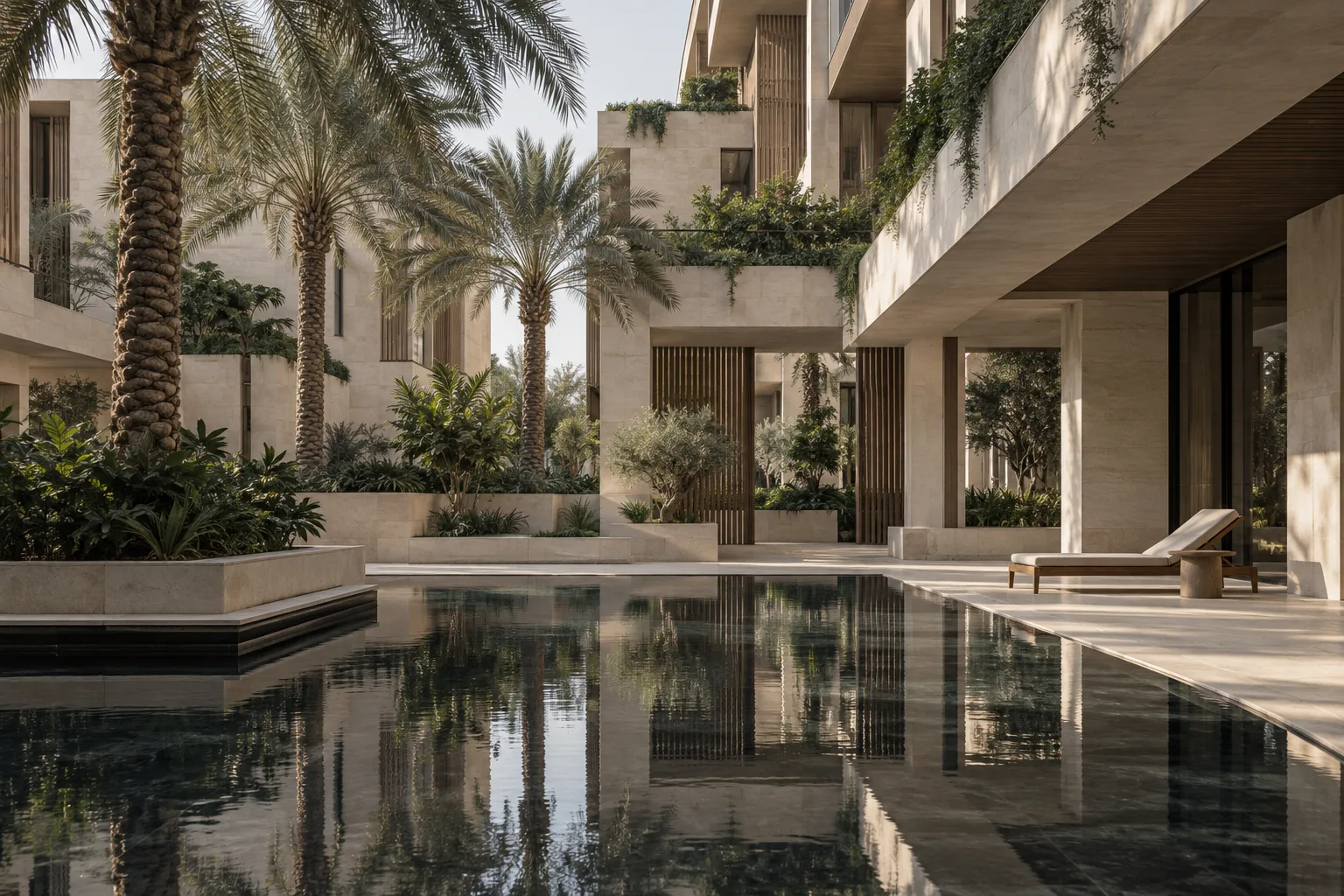
Wellness is the fastest-growing category in global real estate, and it is also the least defined. A development can be marketed as a wellness address because it was designed around light, air, movement and materials from the structural drawings onwards, or because it has a spa on the fourth floor and a yoga lawn in the render.
Both are sold with the same vocabulary. Only one of them is a reason to pay more.
This guide separates the category from the label. What wellness real estate means to the people who measure it, what can actually be verified before you buy, what the amenities cost you every year after you do, and the question that decides whether any of it holds its value: what happens to the promise after handover.
THE CATEGORY IS REAL, AND GROWING FASTER THAN THE MARKET AROUND IT
This is not a marketing invention. The Global Wellness Institute, which has sized the sector since 2013, puts global wellness real estate at $876 billion in 2025, up from $151 billion in 2017, and projects $1.8 trillion by 2030. Its measured growth from 2019 to 2025 averaged 23.6% a year: roughly double the next-fastest wellness sector. For scale, GWI notes that from 2024 to 2025 wellness real estate grew 23% while global construction overall grew 3%.
The regional and UAE picture is where it becomes locally relevant. GWI sizes the Middle East and North Africa market at $42.6 billion in 2025, growing at 30.3% a year since 2019: the second-fastest growth rate of any region it tracks. The UAE specifically sits at $15 billion in 2025, growing 25.1% annually from 2019 to 2025, placing it inside GWI's top fifteen national markets.
Source: Global Wellness Institute, "Wellness Real Estate Market Reaches $876 Billion," 12 May 2026: a data preview of the 2026 Wellness Economy Monitor. Figures are GWI's own estimates on GWI's definition of the category, which is broader than branded wellness residences alone. Check the current release before relying on any of these numbers, as they are revised annually.
Two things follow from that data, and only two. The category has genuine scale and genuine momentum in this market. It does not follow that any individual building carrying the label participates in either.
WHAT WELLNESS REAL ESTATE ACTUALLY MEANS
GWI's working definition is useful precisely because it is demanding: built environments proactively designed, built and operated to support the holistic health of occupants, visitors and the community. Three verbs, and the third one is where most developments fail. Designed and built are one-time events. Operated is forever.
In practice, developments that meet the description tend to address some combination of the following. This is a checklist for reading a brochure, not a guarantee of quality:
Light. Orientation and glazing that maximise daylight, and interior lighting designed to track circadian rhythm rather than simply illuminate.
Air and water. Filtration specification, ventilation rates, humidity control, and water treatment at building level rather than a filter under the kitchen sink.
Biophilic design. Substantial and integrated natural elements, such as planting, water and natural materials, used as structure rather than decoration.
Movement. Layouts that make stairs, walking routes and outdoor space the natural choice, not just a gym residents have to decide to visit.
Programming and services. Classes, nutrition, recovery facilities, medical concierge. The most visible in marketing and the least permanent in reality.
Read that list against the building you are being sold. A development that addresses the first four has made structural decisions that are expensive to reverse and therefore durable. A development that addresses only the fifth has made a staffing decision that can be unwound in a budget meeting.
THE LABEL IS NOT REGULATED. THE CERTIFICATION IS.
There is no legal definition of a wellness development in Dubai or anywhere else, and no regulator tests the claim before it appears in a brochure. Any developer may use the word. That is the single most important fact in this article.
What can be verified is third-party building certification. WELL and LEED are the two most commonly cited, awarded against published standards by bodies independent of the developer and, critically, listed on the certifying organisation's own public register. Fitwel operates similarly. The distinction that matters on a project still under construction is between a building that is certified, one that is registered or targeting certification, and one that is merely "designed to the principles of" a standard. The third is not a certification; it is a sentence.
Ask for the certification, the level, the issuing body and the date, then confirm it on the certifying body's register rather than in the developer's material. If the answer is that certification is being pursued, ask what happens commercially if it is not awarded. Usually, nothing happens. That tells you how firm the commitment was.
Where a facility offers anything clinical (diagnostics, IV therapy, physician-led longevity programmes) it moves out of leisure and into health regulation. In Dubai that is the Dubai Health Authority; in Abu Dhabi it is the Department of Health – Abu Dhabi, which replaced the former HAAD. Confirm the operator holds the correct licence for the specific services advertised. A building approval does not license a clinic inside it.
THE RECURRING COST NOBODY PUTS IN THE BROCHURE
Wellness amenities are not free after purchase. Every one of them is an operating cost, and operating costs are recovered from owners through the annual service charge.
Consider what the marketing describes as lifestyle and the building manager describes as a budget line. Temperature-controlled pools and cold plunge facilities consume energy continuously. Living walls and extensive soft landscaping need irrigation, replanting and horticultural labour. Advanced air and water filtration means filter replacement on a schedule and specialist servicing. Treatment rooms, studios and concierge desks need staff. None of that is a criticism. It is what makes the difference real rather than cosmetic. But it is charged annually, per square foot, for as long as you own the property.
So get the number. Ask for the current service charge per square foot, ask what it was in each of the last three years, and compare it against conventional buildings in the same community. Our guide to Dubai service charges explains how the charge is set and where to check it. If you are underwriting the property as an investment, the charge belongs in the yield calculation before you compare it to anything: see our rental yields guide for landlords for how that arithmetic should be built.
A premium purchase price and a premium running cost are two separate decisions, and the second one compounds.
THREE ROUTES INTO THE CATEGORY
Broadly, there are three ways to buy into wellness real estate in this market, and they carry different risks rather than different amounts of the same risk.
Branded residences with a wellness operator
A hospitality or wellness brand attaches its name and, usually, its operating standards to a residential development. The brand is doing real work here: it carries recognition with international buyers and it imposes a specification the developer must meet. The questions to ask are contractual. How long does the operating agreement run? What happens to the branding and the service standard if it is not renewed? Is the brand operating the facilities or licensing its name to someone else who is? A twenty-year agreement and a five-year one are very different assets.
Developer-led wellness communities
A master developer positions a whole community around health and outdoor living rather than a single tower. The advantage is that community-scale features (parks, running and cycling routes, shading, walkability, low-traffic layouts) are genuinely structural and cannot be quietly withdrawn. The risk is phasing. Much of what is promised may sit in later phases, and later phases are the ones that move. Establish which amenities exist today, which are under construction with a contract, and which are on a masterplan. Our note on off-plan versus ready property covers how to weigh that gap, and the developer delivery track records are the relevant evidence.
Repositioning an existing asset
Buying a conventional property and upgrading it toward the category. This is not a property transaction with a decorating budget attached. It is a development project, with construction management, community and regulatory approvals, a capital plan and a period of no income. It can suit investors who are equipped to run that. It does not suit investors who want the outcome without the project. Be honest about which you are.
THE QUESTION THAT DECIDES THE INVESTMENT: WHAT SURVIVES HANDOVER?
Everything above resolves into one test. Split the wellness proposition into what is built and what is run.
What is built: orientation, glazing, ventilation and filtration systems, materials, landscaping structure, walkability, certified building fabric: stays with the asset. It is expensive to install and expensive to remove, which is precisely why it is credible. A future buyer inherits it whether or not anyone is still marketing the building as a wellness address.
What is run (classes, therapists, nutrition programmes, medical concierge, the staffed desk) depends on somebody continuing to fund it. Service providers change. Operating agreements expire. Owners' associations under budget pressure cut programming before they cut maintenance. A resale buyer three years from now values what is actually operating on the day they view, not what appeared in the launch brochure.
Before paying a premium, ask which parts of the proposition are contractually committed beyond handover, by whom, and for how long. If the answer is that the developer intends to maintain the standard, you are paying today for an intention. Price it as one.
This is also the honest answer to whether wellness properties command higher prices and yields. Sometimes they do. But the differential varies by building, operator, community and moment, and any single percentage figure quoted across the category is describing a market that does not exist. Build the comparison yourself, from transacted prices for genuinely comparable units, net of the service charge. Our guide to choosing an area in Dubai covers the comparable-selection discipline that makes such a comparison meaningful.
EIGHT QUESTIONS BEFORE YOU COMMIT
- Is the building certified, registered, or neither? Get the standard, level, body and date, then verify it on the certifier's register.
- Which features are structural and which are services? The split predicts what still exists in five years.
- What is the service charge per square foot, and its three-year history? Compare it to conventional stock in the same community.
- Who operates the wellness facilities, under what agreement, for how long? Ask what happens at expiry.
- Are clinical services correctly licensed by the DHA or DoH? Confirm for the specific services advertised.
- Which amenities exist now, and which are in a later phase? Get it in writing, with dates and contract status.
- What do comparable units actually transact at? Transacted evidence, not asking prices, and net of service charge.
- Who is your exit buyer? If the answer requires the wellness programming to still be running, you are exposed to somebody else's operating budget.
WELLNESS REAL ESTATE FAQ
What counts as wellness real estate?
GWI defines it as built environments proactively designed, built and operated to support occupants' holistic health: design decisions across light, air, water, movement and materials, not a spa added to a conventional building. The term itself is unregulated, so any developer may use it.
Is wellness real estate a regulated category in Dubai?
No. There is no legal definition and no regulator tests the claim. What is verifiable is third-party certification such as WELL or LEED, checkable on the certifying body's own register. Certification is evidence; the label is a claim.
Do wellness amenities increase service charges?
They can, materially. Pools, spa facilities, living walls, advanced filtration and programmed staffing are recurring costs recovered annually from owners. Get the current charge per square foot and its history before assuming the premium is worth paying.
Do wellness facilities with medical services need a licence?
Yes. Diagnostics, IV therapy and physician-led services fall under health regulation: the Dubai Health Authority in Dubai, the Department of Health – Abu Dhabi (formerly HAAD) in Abu Dhabi. Confirm the licence covers the specific services advertised.
Does a wellness development hold its value better on resale?
It depends on whether the features are structural or operational. Building fabric stays with the asset; programming and staffing can be withdrawn. Ask what is contractually committed beyond handover and what is discretionary.
HOW MISTER SEVEN WORKS WITH BUYERS IN THIS CATEGORY
Mister Seven is a multi-disciplinary advisory group operating across seven pillars (brokerage, development, advisory, legal, finance, concierge and technology) from Business Bay. For a buyer considering a wellness-positioned property, the useful consequence of that structure is that the certification question, the operating agreement, the service charge history and the transacted comparables can be examined together rather than separately.
Our starting position on this category is scepticism, not enthusiasm. The growth in the sector is real and documented. Whether a specific building justifies a specific premium is a question of evidence, and often the evidence does not support it. If that is the conclusion for the property in front of you, that is the advice you will get.
HAVE A WELLNESS PROPERTY REVIEWED
Send us the development you are considering. We will come back with the certification position, the operating and service charge exposure, and what genuinely comparable units have transacted at, before you commit to the premium.
Request a Property Review →sales@mr7.ae · +971 58 598 7777 · C101, The Opus Tower, Business Bay, Dubai
Run your own numbers with the Dubai property ROI calculator, or contact the team.
© 2026 Mister Seven · mr7.ae · The Opus, Business Bay, Dubai